Most conversations about food security start with production: how much is grown, how many hectares are planted, how much the country harvests in a year. But none of that answers the question a household asks while standing in a market: can I trust what I find here today?
Reliable food access is not the same as available food. Availability is a supply question. Reliability is a design question and it is one most food systems never properly solve.
What “reliable” means to a household
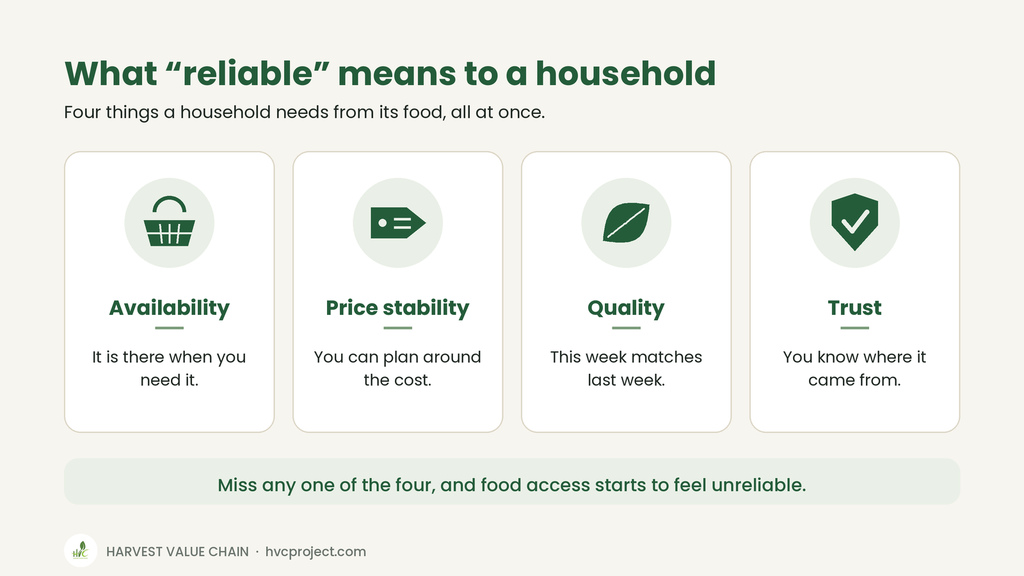
Ask a household what makes food access reliable and you rarely hear “more farms.” You hear something closer to this: I know where to get it, I know roughly what it will cost and I trust what I am buying.
That is four separate things: availability, price stability, quality and trust. A food system can fail on any one of them while succeeding on the rest. A market can be full of produce and still feel unreliable if prices swing without warning or quality changes from one vendor to the next.
Reliability starts at the farm
On our farm, we grow organic cucumbers, peppers, tomatoes and raise catfish. What we have learned is that consistency at the source is what makes everything downstream possible. A household cannot trust a product it has never been able to predict and a product cannot be predictable if the way it is grown and handled changes every week.
Protein is often the hardest part of household food to plan around. It spoils fastest and its price moves the most. Our catfish are fed daily and weighed before they leave the farm. It is a small step, but small steps like this are where predictable supply begins.
Where FoodFreedom comes in
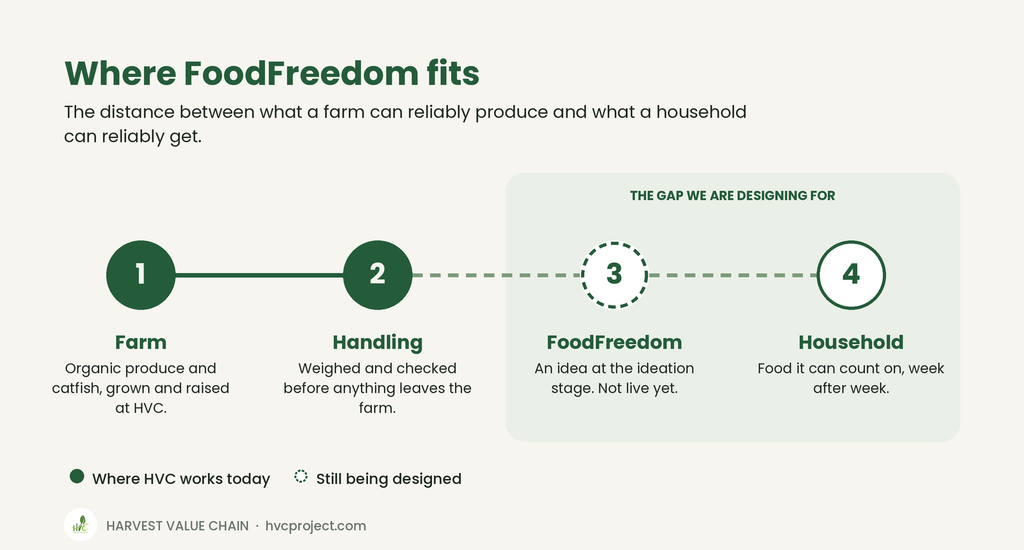
This is the gap we want FoodFreedom to close: the distance between what a farm can reliably produce and what a household can reliably get.
To be clear about where it stands: FoodFreedom is at the ideation stage. It is not live yet and it is not serving households today. Right now it is an idea we are shaping and we would rather shape it in the open than announce something that does not exist.
The principle behind it is already clear. Convenient, fairly priced and trustworthy food depends on every step between the farm and the table being designed with the household in mind, not just the market.
Help us shape it
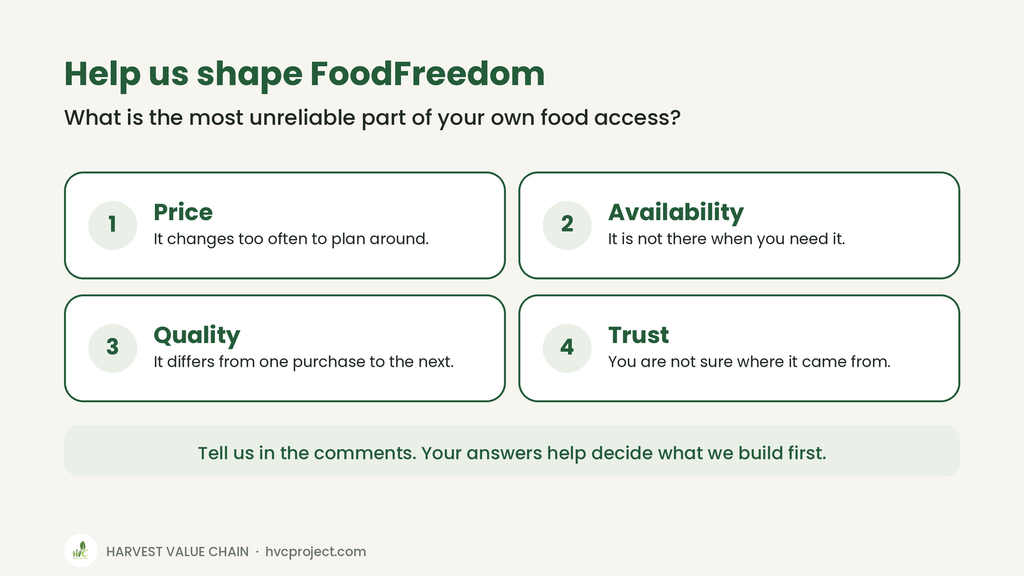
Your input matters more than it will later. If you had to name the single most unreliable part of your own food access, what would it be?
- Price: it changes too often to plan around
- Availability: what you need is not there when you need it
- Quality: it varies from one purchase to the next
- Trust: you are not sure where it came from
Tell us in the comments.
This is what “Infinite Possibilities” looks like from a household’s side of the table. Not just growing more, but designing for food that reaches people reliably.
Follow:
- Website: Explore HVC
- Linkedin:Follow us