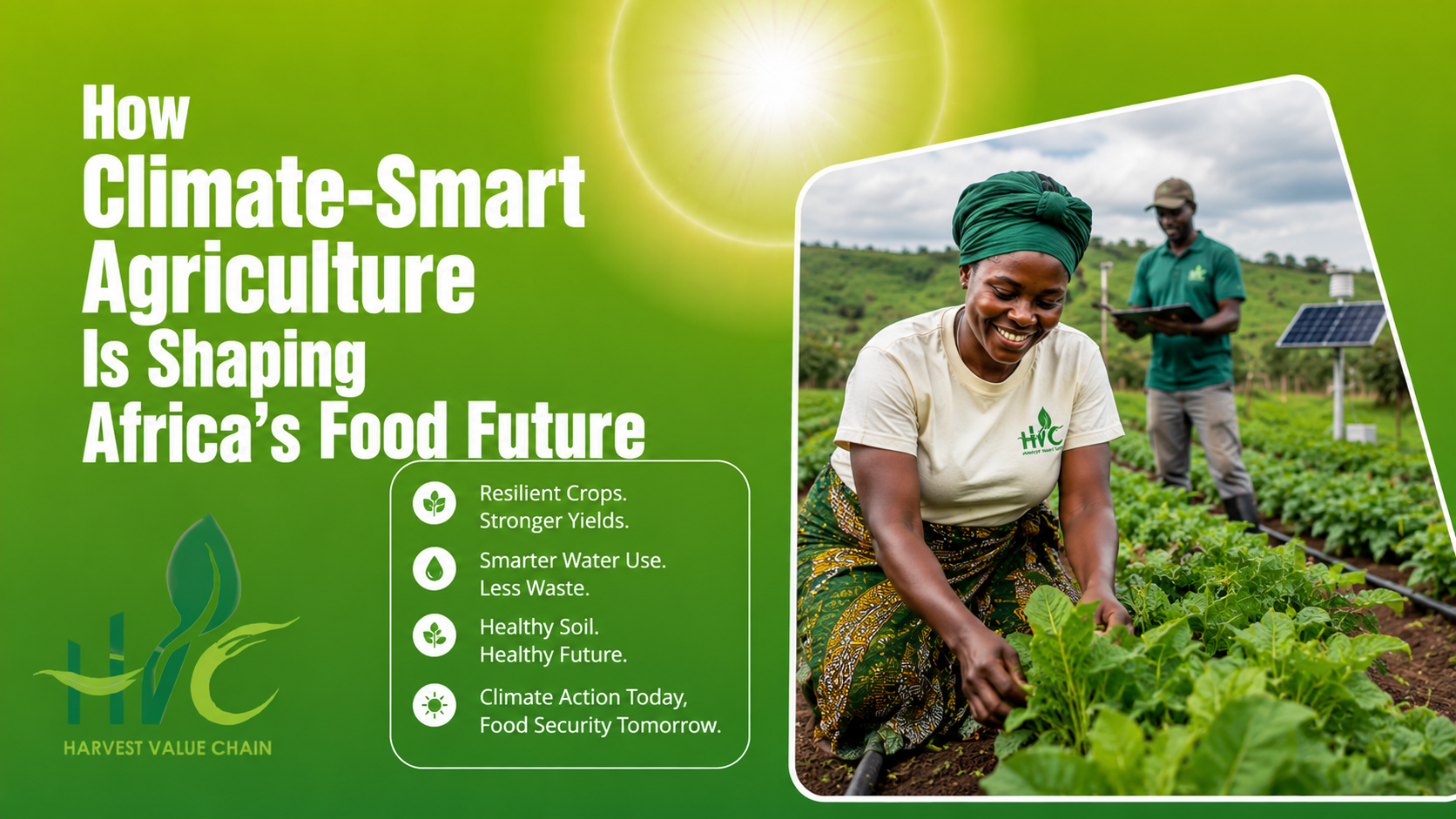
A Harvest Value Chain Limited Insight
Africa’s food future is facing a difficult equation: produce more food while dealing with a changing climate. Rising temperatures, unpredictable rainfall, droughts, floods and soil degradation are putting pressure on farmers and food systems across the continent. At the same time, Africa’s population and demand for food continue to grow.
This is where Climate-Smart Agriculture (CSA) comes in.
Climate-smart agriculture is an approach designed to increase productivity and incomes, strengthen resilience to climate change, and reduce greenhouse-gas emissions where possible. For Africa, it could become one of the most important tools for building a more productive and resilient food system.
What Does Climate-Smart Agriculture Look Like?
Climate-smart agriculture isn’t one particular farming method. It can include different practices and technologies depending on the location and farming system. Examples include:
- Climate-resilient crop varieties that tolerate drought, heat or flooding
- Efficient irrigation and water-management systems
- Agroforestry, combining trees with crops or livestock
- Conservation agriculture to protect soil
- Precision farming to use water, fertiliser and other inputs more efficiently
- Improved livestock management
- Weather and climate information to support better decisions
The goal is simple: Produce more, withstand climate shocks and use resources more efficiently.
Why Africa Needs It Now
Smallholder farmers are particularly exposed to climate risks because many depend heavily on rainfall and have limited access to irrigation, finance, insurance and technology.
FAO reports that extreme weather events such as droughts and floods are already threatening livelihoods, food security and access to healthy diets, with smallholder farmers among those most exposed. This makes climate-smart agriculture more than an environmental issue.
It is a food-security and economic issue;
When a drought destroys crops, farmers lose income; When floods damage farms, food supplies fall; When soil quality declines, productivity suffers; And when production becomes less predictable, food prices can rise; Building resilience at farm level therefore strengthens the wider food value chain.
Technology Is Changing the Game
Technology is becoming an important part of climate-smart agriculture. Farmers can increasingly use tools such as:
- Weather forecasting
- Satellite crop monitoring
- Digital advisory platforms
- Soil sensors
- Smart irrigation
- Solar-powered pumps
- Mobile-based market information
These technologies can help farmers make better decisions about when to plant, when to irrigate and how to manage inputs.
FAO reported in 2026 that climate-resilient agriculture, digital tools and innovation were being expanded across Africa to help farmers and institutions respond to growing climate risks.
The opportunity isn’t limited to large commercial farms. Affordable, scalable technologies could make climate-smart solutions increasingly accessible to smallholders.
Climate-Smart Agriculture Is Also a Business Opportunity
This is where the conversation becomes particularly interesting for entrepreneurs. Climate-smart agriculture is creating demand for businesses that provide:
- Irrigation systems
- Improved seeds
- Agricultural technology
- Weather information
- Farm advisory services
- Renewable energy
- Soil-management solutions
- Climate-smart inputs
- Agricultural insurance
- Storage and post-harvest solutions
The African Development Bank is already supporting climate-smart technologies and resilient agricultural value chains, while its 2026 agriculture review identifies climate shocks, infrastructure and technology gaps as major constraints to Africa’s food-system transformation. In other words, climate adaptation is becoming an economic sector of its own.
But Climate-Smart Agriculture Isn’t a Magic Fix
Here’s the part that often gets ignored. Simply introducing a new technology does not automatically make a farm profitable.
A 2025 meta-analysis of studies from sub-Saharan Africa found positive associations between climate-smart agriculture and crop and household incomes but also highlighted the importance of complementary support such as extension services, markets, insurance and finance.
Farmers still need: Knowledge + finance + markets + infrastructure + technology. Without these, even good innovations can fail to scale. That means Africa’s climate-smart transition must involve the entire food value chain, not just farmers.
The Bigger Opportunity for Africa
Climate-smart agriculture should not be viewed simply as “farming differently.” It is about building a stronger food system.
Farmers need resilient production systems; Processors need reliable supplies; Consumers need affordable food; Businesses need predictable markets; And entrepreneurs need opportunities to solve the gaps connecting all of them.
That is why climate-smart agriculture matters beyond the farm. It can create opportunities across technology, logistics, renewable energy, processing, finance, irrigation and agricultural services. Africa’s food future will depend not only on how much we produce, but how intelligently we produce it.
Final Thought
Climate change is putting pressure on Africa’s food systems—but it is also forcing innovation. The winners will not necessarily be those who farm the most land. They will be the farmers, entrepreneurs, businesses and institutions that learn how to produce efficiently, adapt quickly and create more value from every resource.
At Harvest Value Chain Limited (HVC), we believe the future of African agriculture lies in connecting production with technology, sustainability, markets and value addition. Climate-smart agriculture isn’t just about surviving tomorrow’s climate. It’s about building a food system capable of feeding Africa tomorrow.
- Finding the Next Useful Form of Agricultural Matter, Where Nothing Is Truly Waste
- Harvest Value Chain Champions Circular and Sustainable Agriculture In Kwara State (CIWACIWE)
- How Post-Harvest Value Addition Reshapes Agricultural Enterprise
- NiMet’s 21–31 August Flash-Flood Outlook: What It Means for Agriculture, Infrastructure and Logistics
- How Climate-Smart Agriculture is Shaping Africa’s Food Future
About HVC
Harvest Value Chain Limited (HVC) focuses on practical solutions and opportunities across agriculture, food production, sustainability, value addition and market development. From farm to market, value is created at every step.