Someone tells you they want to go into agriculture. Your next question is probably, “What do you want to farm?” Their answer might be tomatoes, maize, poultry or catfish. Soon, the conversation turns to land, feed, seeds and how much money they need to start.
These are useful questions. But they can make agriculture feel closed to anyone who does not own land or have the resources to produce something.
Think about what happens around a farm. Someone supplies the seedlings. Someone repairs the irrigation system. Someone finds buyers, sorts the harvest, arranges transport and keeps the records. When produce cannot be sold fresh, someone may be able to process it into a different product.
Each of these activities solves a problem. Some can become businesses.
The starting point is to find a problem people experience often enough that they are willing to pay for a reliable solution.
Start with a problem you can see
Imagine a vegetable grower with cucumbers ready for harvest. A restaurant nearby buys cucumbers every week, but its manager does not know this grower exists. A retailer wants a smaller quantity than the grower prefers to sell. Transport is available, but hiring a vehicle for one small delivery would consume much of the margin.
There is produce. There are potential customers. Yet the sale is still difficult.
Growing more cucumbers would not resolve those particular gaps. Better coordination might.
This is where people with skills in communication, logistics, record-keeping, food handling and business management can contribute. The question becomes: which part of the problem can you solve well enough for someone to pay you?
Here are nine possibilities to investigate.
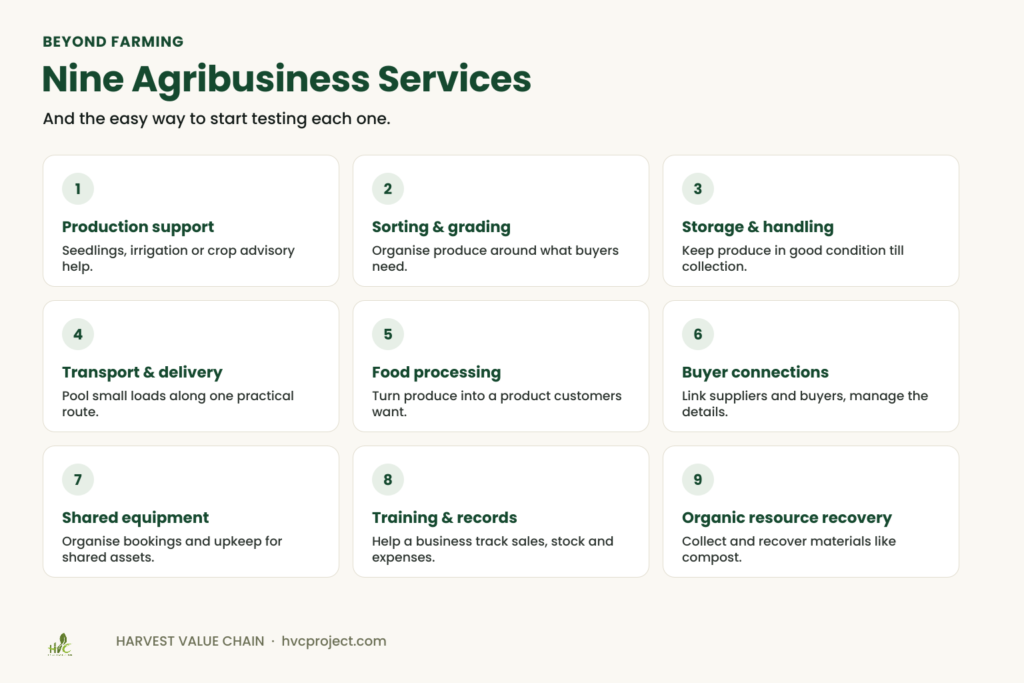
1. Help growers improve production
A farmer may have land and customers but struggle with weak seedlings, uneven watering or poor production records. Someone with the right technical knowledge can build a service around those needs.
This could involve raising healthy seedlings, maintaining irrigation equipment or providing crop advisory support within their area of competence.
For example, a nursery operator could supply vegetable seedlings to growers who prefer to buy established plants. The customer pays for the seedlings and the care invested in producing them.
Before filling hundreds of nursery trays, speak with nearby growers. What varieties do they use? When do they plant? How many seedlings do they buy? What problems have they experienced with previous suppliers?
Start with an order or a small trial batch. Record how many seedlings survive, what they cost to raise and whether customers return.
Production support depends on trust. Advice should come from appropriate training and experience. Where specialist expertise is needed, work with a qualified adviser.
2. Sort and grade produce for particular buyers
A basket of tomatoes may contain firm fruits suitable for a longer journey, ripe ones needed immediately and damaged ones that should be separated. If everything is mixed together, a buyer has to do that work or account for the uncertainty when negotiating.
A sorting and grading service helps organise produce around agreed requirements. A restaurant may want consistent sizes. A retailer may prioritise appearance. A processor may accept different sizes while requiring sound, safe raw material.
The service could earn a handling fee from growers or operate through an agreed supply arrangement with buyers.
Start by asking one buyer to explain exactly what they accept. Then test whether you can prepare a small batch consistently.
Sorting takes labor, space and suitable containers. There will also be rejected material to account for. A better selling price only helps if it covers the additional work and losses.
3. Offer suitable storage and handling services
Sometimes a farmer has a buyer, but collection will happen tomorrow. The immediate problem is keeping the produce in an acceptable condition until then.
Depending on the commodity, a useful service might involve a shaded collection point, clean crates, a managed holding area or access to appropriate cooling.
Customers could pay by crate, quantity or storage period. The arrangement needs clear rules about collection, handling and responsibility for losses. Before investing in a cold room, investigate the demand. Which products need storage? In what quantities? For how long? What can customers afford to pay?
Where possible, test demand through an existing facility before building your own.
Storage also requires technical care. Temperature and humidity requirements differ between products. Electricity, maintenance, cleaning and equipment failure affect the service cost.
The business is the ability to preserve quality reliably, not simply ownership of a storage facility.
4. Coordinate transport and deliveries
A farmer has six crates to move. Another nearby has four. Separately, neither has enough produce to make a dedicated trip economical.
A transport coordinator can investigate whether these loads can be collected along a practical route and delivered to buyers. You may be able to begin by working with an existing driver rather than purchasing a vehicle. Revenue could come from an agreed delivery charge.
But a route that looks simple on paper can become expensive when one farmer is not ready, a buyer changes the delivery time or produce waits too long during collection.
Test with a small number of dependable suppliers and buyers. Record travel time, loading, fuel, waiting and damage. Agree who pays when a delivery fails. Make sure products travelling together can be handled safely.
A good transport service saves customers time and uncertainty as well as moving goods.
5. Process produce into a product customers want
Fresh produce does not always reach a buyer in time. Where suitable raw material and demand exist, processing may offer another route to market. Examples include drying pepper, milling grains or producing an appropriately preserved food product.
However, surplus alone is not a business model. You still need customers who want the finished product at a price that covers production.
Before buying equipment, investigate a specific market. What does the customer currently buy? In what quantity? What do they dislike about the available product? Would they place a trial order?
A small pilot through a suitable processing facility can help you understand yield, labour, packaging and customer response.
Food safety is essential. Processing is not a way to rescue spoiled or unsafe ingredients. Suitable facilities, validated methods, relevant approvals and appropriate packaging all need attention before commercial sale.
6. Connect suppliers with buyers
A grower may know how to produce but have limited time to search for customers. A restaurant may spend hours contacting different suppliers to find the quantity and quality it needs.
A market coordination service can help both sides plan.
This work involves more than sharing telephone numbers. It may include checking availability, confirming specifications, communicating prices and following up on delivery.
Revenue could come from a transparent commission or an agreed sourcing fee. Start with one commodity and a manageable group of suppliers and buyers. Keep records of quantities, quality requirements, delivery dates and payment terms.
Be clear about your role. Are you introducing the parties, buying and reselling produce or accepting responsibility for delivery? Each arrangement carries different obligations.
A useful connection becomes valuable when people can rely on the information behind it.
7. Manage access to shared equipment
Some growers need equipment occasionally but cannot justify owning it individually. Others own equipment that sits unused between jobs. A service could help organise bookings, operators, maintenance and payment for shared assets.
Depending on local demand, this might involve irrigation pumps, processing equipment or other agricultural machinery. Potential customers pay for access to a functioning service. That means availability, safe operation and clear charges matter.
Before buying an asset, speak with existing owners and potential users. Could you first coordinate bookings for equipment already available?
Check whether demand falls within the same narrow seasonal window. Ten interested customers are less useful if all ten need the machine on the same morning. Shared ownership also needs rules. Maintenance, breakdowns, missed bookings and unpaid fees can quickly create disagreements.
This opportunity is about making equipment access dependable. Any lending or investment activity requires separate attention to the relevant legal requirements.
8. Provide practical training and record-keeping support
Some business problems begin with information that is missing or difficult to use.
A farmer may know the total value of a sale but have no record of transport and packaging expenses. A processor may struggle to track stock. Workers may need practical instruction on handling produce consistently.
Someone with the appropriate competence can offer focused support. This could mean setting up simple sales records, helping an enterprise track inventory or delivering hands-on training in a skill they are qualified to teach.
Start with a specific task. “Helping a vegetable business record daily sales and expenses” is easier to assess than “transforming agribusiness through capacity building”.
Agree on the work, the fee and the expected outcome. Then check whether the customer can actually use what you have introduced.
A useful service leaves the business better able to operate after you leave.
9. Collect and recover suitable organic materials
A produce seller may need vegetable residues removed regularly. A grower may need compost. Connecting these needs could create a business, provided the materials can be handled and processed safely.
An operator might earn income through collection, the sale of a suitable recovered product or both. Start by identifying a controlled source of material. Mixed waste can contain plastics, chemicals and other contaminants that make recovery difficult or unsafe.
Next, investigate who would buy the output. What quality do they require? How much do they use? Can you supply it consistently?
Collection, sorting, transport, processing space and testing all cost money. Organic material can also be bulky and expensive to move.
Begin with one manageable material stream and an appropriate recovery method.
More complex uses, including animal feed and energy production, require specific technical expertise and attention to applicable standards.
How do you choose where to begin?
You do not need to pursue all nine. Choose one problem you can observe closely.
Visit the people experiencing it. Ask them what happened the last time the problem occurred, what it cost them and how they currently manage it.
Then ask yourself:
- Who would pay for this service?
- What exactly would they receive?
- How often would they need it?
- What skills, permissions or partners would I need?
- What would delivery cost?
- Can I test it before making a large investment?
Pay attention to actions as well as encouragement. Someone saying “This is a good idea” is different from agreeing to a paid trial.
After the trial, record the full cost. Include transport, labour, rejected products, communication and your own time. Ask whether the customer would pay again.
A small service with repeat customers gives you stronger evidence than an ambitious plan nobody has paid to use.
Agriculture needs more than people who produce
For a harvest to become useful food and sustainable income, many things have to work together.
Quality must be protected. Buyers need reliable supply. Equipment needs maintenance. Records need keeping.
These are practical needs that people can build skills and businesses around.
Your turn
Which of the nine would you build and why? Tell us in the comments. We read every reply, and your answers help shape what we talk about next.
At HVC, “Infinite Possibilities” includes looking closely at those connections and asking what agricultural resources, skills and relationships can become.