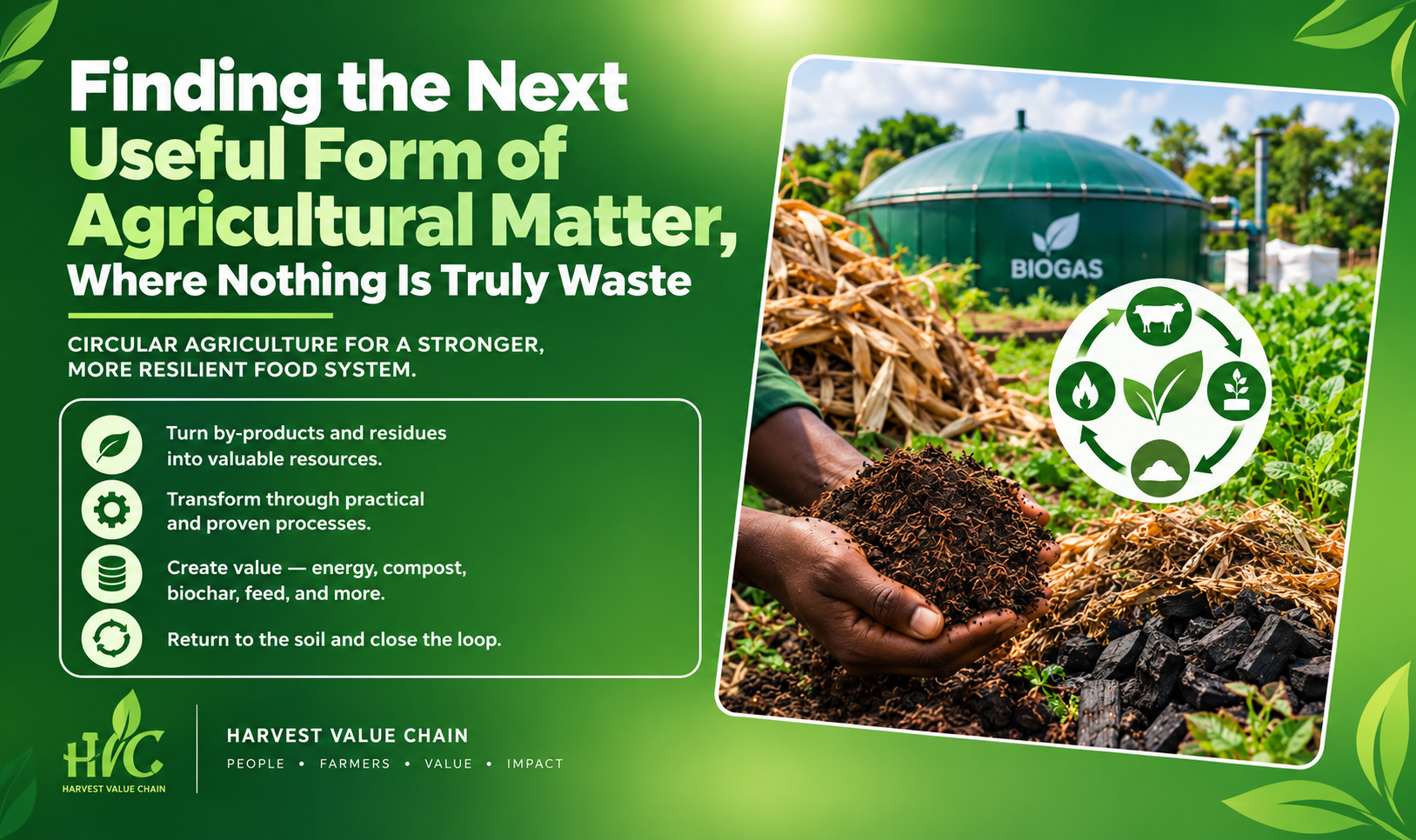
In nature, very little truly goes to waste. A fallen leaf breaks down, returns nutrients to the soil, and supports new growth. Organic matter moves from one stage to another, creating a continuous cycle of use and renewal. Agriculture can work the same way. For years, agricultural production has often followed a linear pattern: produce, harvest, sell, and discard what remains. Crop residues, animal manure, processing by-products, and other organic materials are frequently treated as waste once their primary purpose has been served. But what if the end of one process could become the beginning of another? This is the thinking behind circular agriculture, an approach that looks beyond production alone and asks how resources can be kept in use for as long as possible.
The principle is simple: there is no final waste, only the next useful form of agricultural matter.
From Waste to Resource
The first step is changing how agricultural by-products are viewed. Crop stalks, rice husks, maize residues, fruit peels, livestock manure, and food-processing by-products may appear to have little value after harvest or processing. Yet many contain nutrients, organic matter, energy, or other useful properties.
Instead of treating them as disposal problems, farmers and processors can see them as resources within the value chain.
For example, livestock manure can become an input for biogas production. Crop residues can be converted into compost or biochar. Food-processing by-products can be repurposed as animal feed or other useful materials.
The question changes from “How do we get rid of this?” to “What can this become?”
Transforming Agricultural Matter
Once a by-product is identified as a resource, the next step is transformation. Different materials require different approaches, but several circular processes are already being used across agriculture:
- Anaerobic digestion: Organic materials such as manure and food waste are broken down in an oxygen-free environment to produce biogas and nutrient-rich digestate.
- Biochar production: Crop residues can be heated under limited oxygen to produce biochar, a carbon-rich material that can be incorporated into soil.
- Composting: Organic residues are biologically broken down into a stable material that can return nutrients and organic matter to the soil.
- Bioprocessing: Certain agricultural residues can be processed into useful compounds, materials, fuels, or other products.
These processes demonstrate an important point: value does not necessarily disappear when a crop leaves the farm gate, sometimes, it simply changes form.
Creating Value Beyond the Farm Gate
Circular agriculture is not only about reducing environmental impact. It can also create new economic opportunities across the agricultural value chain.
Agricultural by-products can support:
- Energy production through biogas
- Soil improvement through compost and biochar
- Animal feed from suitable processing by-products
- Alternative materials and packaging from agricultural biomass
- New products and enterprises built around materials previously considered waste
This creates opportunities for farmers, processors, entrepreneurs, and other value-chain actors to generate additional value from resources that might otherwise be discarded.
In other words, circular agriculture can turn a cost of disposal into an opportunity for value creation.
Closing the Loop
The real strength of circular agriculture comes from what happens after transformation. The products created from agricultural by-products can return to the production system.
Compost and suitable biochar can be incorporated into agricultural soils. Digestate from biogas systems can be used as a nutrient source, subject to appropriate handling and application practices. Organic residues can be redirected into other productive uses.
The result is a system where fewer resources leave the value chain as waste. Instead, materials move from production to processing, from processing to reuse, and from reuse back into production. The loop becomes tighter.
A Different Way of Thinking About Agriculture
Circular agriculture does not mean that every agricultural residue must be converted into something new. Nor does it mean that every circular solution will make economic sense for every farm.
The real opportunity is to understand what resources are available, identify their most practical next use, and build systems that make that use economically and environmentally viable.
For farmers and processors, this could mean reducing input costs, creating additional revenue streams, improving resource efficiency, and reducing losses.
For the wider food system, it means moving away from a model where resources are extracted, used once, and discarded.
Agriculture has always depended on cycles. Circular agriculture simply brings that principle back into sharper focus.
There is no final waste. There is only the opportunity to find its next useful form.
At Harvest Value Chain (HVC), we believe that strengthening food systems requires looking beyond production and understanding how resources, people, and opportunities connect across the entire value chain. The future of agriculture will not only be about producing more; It will also be about using more of what we already produce.