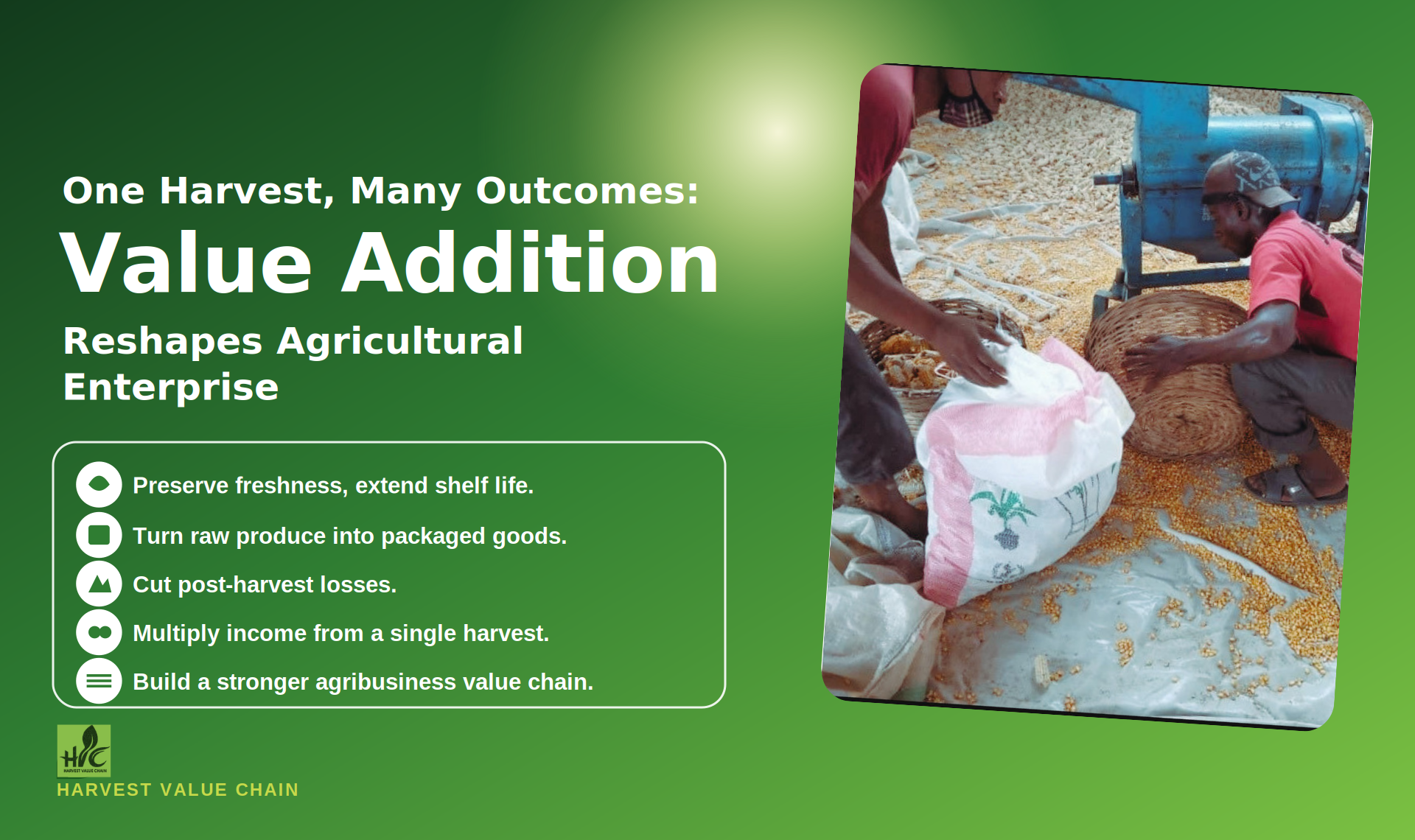
For many agricultural businesses, the harvest is treated as the finish line. Crops are harvested, taken to market, sold, and the cycle begins again. But what if the harvest is actually the starting point for several different businesses? This is where post-harvest value addition changes the agricultural enterprise.
Selling fresh produce can generate income, but it also exposes farmers and producers to seasonal price drops, perishability, transportation challenges, and post-harvest losses. When too much produce reaches the market at the same time, prices can fall sharply. Produce that does not sell quickly may deteriorate, turning potential income into waste.
Value addition offers another pathway.
Instead of viewing agricultural output as a finished product, we can view it as a resource with multiple possibilities.
Start With Quality
Value addition does not begin inside a processing facility. It begins on the farm.
The quality of the final product depends heavily on what happens before processing starts. Harvesting at the right stage, careful handling, proper sorting, and appropriate storage can determine how much value can eventually be extracted from the crop.
Simple practices such as:
- Harvesting at the appropriate maturity stage
- Reducing physical damage during harvesting and transportation
- Sorting and grading produce
- Removing damaged or contaminated materials
- Managing temperature and moisture
- Moving produce quickly into storage or processing
can significantly improve the quality and marketability of agricultural products.
The goal is simple: preserve as much value as possible before adding even more value.
From Fresh Produce to Market-Ready Product
The next opportunity lies in processing.
Primary processing can turn freshly harvested commodities into products that are easier to store, transport, and use.
Cleaning, drying, threshing, dehulling, milling, and other basic processes can reduce perishability while making agricultural products more suitable for different markets.
But the possibilities go further.
- Secondary processing can transform commodities into entirely new products.
- Tomatoes can become paste or dried tomatoes.
- Cassava can become flour or starch.
- Fruits can become juices, purees, or dried snacks.
- Oilseeds can become cooking oil, while the remaining press cake can become an ingredient for animal feed.
The important shift is this:
You are no longer selling only what you harvested. You are selling what you can create from what you harvested.
Packaging Is Part of the Value
A good product can still struggle in the market if it is poorly packaged.
Packaging protects agricultural products from moisture, contamination, oxygen, light, and physical damage. It can also extend shelf life and make transportation and storage easier.
But packaging does something else: it communicates value.
A properly packaged product can move from a farm-gate commodity to a retail product.
Clear labeling, nutritional information, appropriate sizing, traceability, branding, and regulatory compliance can help build consumer confidence and open access to more formal markets.
The difference can be significant.
Raw produce → processed product → packaged product → branded product.
With every step, new market opportunities can emerge.
One Crop Can Create Several Revenue Streams
One of the most powerful ideas in modern agriculture is that the main product does not have to be the only product.
Consider what happens when agricultural “waste” is viewed differently.
- Rice bran can become an input for animal feed.
- Fruit peels and organic residues can become compost or bioenergy feedstocks.
- Oilseed press cake can become livestock or aquaculture feed.
- Crop residues can be converted into soil amendments or other useful resources.
This creates a more circular agricultural system where materials remain useful for longer rather than immediately becoming waste.
The objective is not simply to produce more.
It is to extract more value from what is already being produced.
Value Addition Opens More Markets
Processing and packaging can also change who you are able to sell to. A farmer selling fresh produce may primarily depend on local traders and open markets. A processed and standardized product can potentially serve:
Retail consumers
Branded products can enter supermarkets, specialty stores, and other retail channels.
Businesses and institutions
Food processors, restaurants, bakeries, caterers, and other businesses may require standardized agricultural ingredients in larger quantities.
Regional and international markets
Products with longer shelf lives and appropriate quality and regulatory standards can travel further, creating opportunities beyond the immediate local market.
This diversification matters because depending on a single market or buyer creates vulnerability. More products and more markets can mean more options when market conditions change.
From Harvest to Value Chain
Agriculture is bigger than production. It is production, aggregation, processing, packaging, distribution, marketing, technology, energy, and people working together. That is why the real opportunity may not be in asking:
“How much can we produce?”
but also:
“How much value can we create from what we produce?”
At Harvest Value Chain, we believe agricultural resources should not be viewed only through the lens of what they are today, but also through what they can become.
A single harvest can feed a household.
It can supply a processor.
It can become a packaged consumer product.
Its by-products can support livestock, soil health, or energy production.
And the businesses created around these activities can generate jobs and strengthen local economies.
Agriculture does not end at harvest. That is where the value chain begins.