Anyone who backs ideas in agriculture sees the same thing: a steady stream of good-sounding proposals, a cold room, a processing unit, a digital platform or an out-grower scheme. In a single paragraph, almost all of them sound promising.
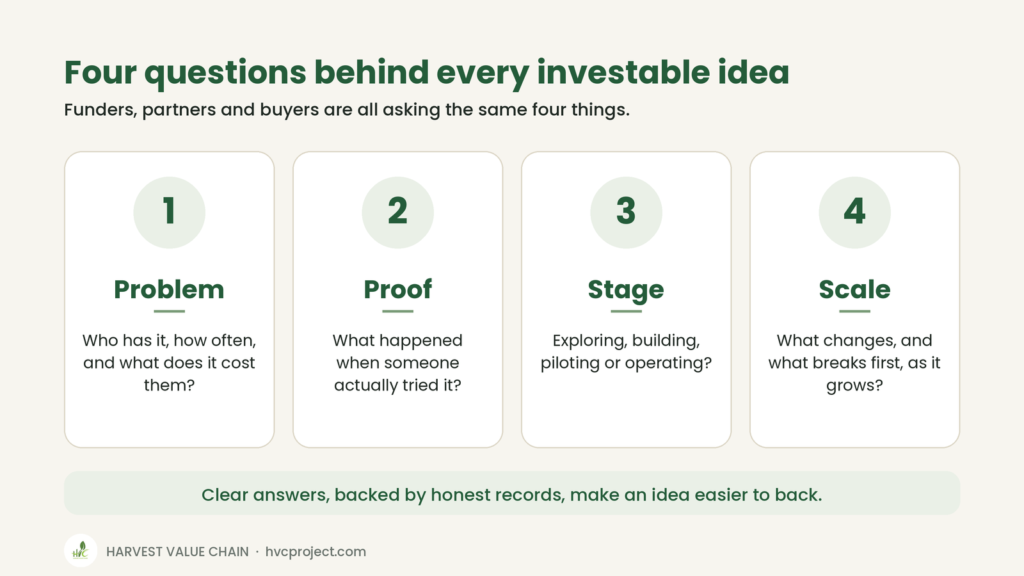
Very few get backed. The difference between the idea that was selected and the others is whether the person behind the idea can answer four plain questions: what is the problem, what is the proof, what stage is it at and what happens when it grows?
“Investable” here does not only mean money from an investor. It also covers a grant, a buyer agreeing to a trial, a partner lending equipment or a mentor giving their time. These are all decisions to back an idea and they are easier to make when the idea is clear and the evidence is honest.
This post is general guidance, not financial or legal advice. Every funder has its own criteria, so check what they ask for.
A running example
To keep this practical, we will use one made-up idea throughout. Imagine a group of vegetable growers in a town where a large part of the harvest spoils before it sells. Someone proposes shared cooling: a place where growers can keep produce for a day or two until a buyer collects it. This is an example, not one of our projects.
1. Problem
Ask this question, who has this problem and what does it cost? Start with the person, not the product. A strong problem statement names who is affected, how often it happens and what it costs them in money, time or lost produce.
“Produce spoils” is a general statement. “Eight growers on this road lose part of their tomatoes two or three times a month because collection comes a day late” is a problem you can measure. The first takes a minute to write. The second takes conversations, a notebook and a few weeks. Funders can tell which one they are reading.
Also ask whether people already pay to deal with the problem. If growers currently pay for ice, rush deliveries or sell cheaply at the last minute, they are telling you the problem has a price.
2. Proof
After noting the problem, the next step is to confirm, what has actually happened? Proof is what happened when someone tried it. It is not what people said they would do. Useful proof includes a small trial (even one that went badly), repeat customers, records of quantities, costs and losses, and a buyer who agreed to a paid trial.
Some things sound like proof but they are majorly enthusiasm, a market size copied from a report or a letter praising the idea without any commitment.
In our example, proof could be five growers using the shared cooler for a month while you record what went in, what came out still sellable, what you charged and who came back. Five growers and four weeks of honest records say more than a polished presentation. Honest records include the bad weeks. A trial that shows what went wrong and what you changed is more credible than one where nothing ever failed.
3. Stage
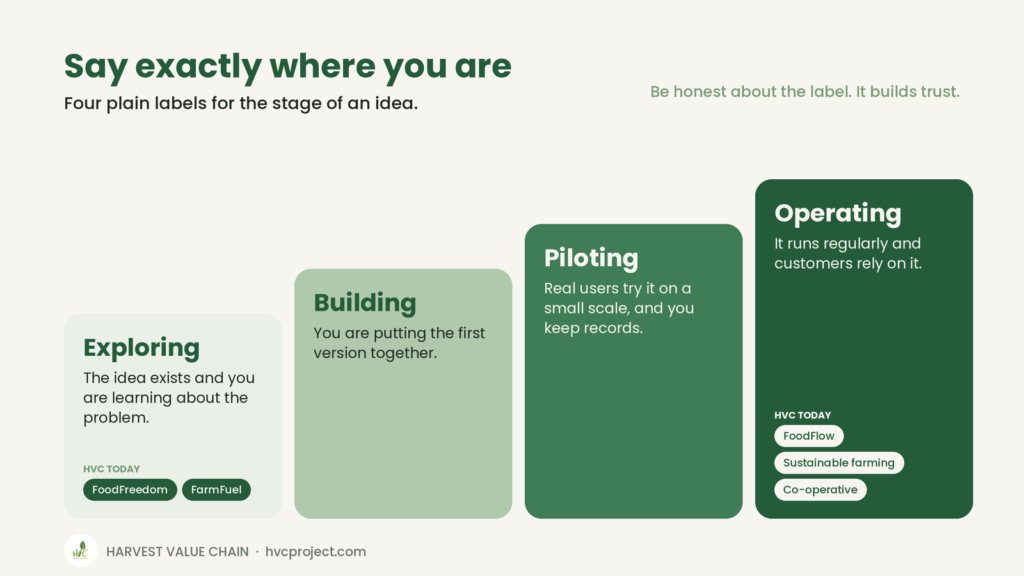
Stage is where an idea honestly sits today. We use four plain labels: exploring (the idea exists and you are learning about the problem), building (you are putting the first version together), piloting (real users are trying it on a small scale) and operating (it runs regularly and customers rely on it).
Overstating your stage is the quickest way to lose trust. A funder who finds out an “operating” project is really an idea will doubt everything else in the pitch. Saying “exploring” costs nothing and builds credibility.
We hold ourselves to this. FoodFlow, our digital platform, is live for users. Our sustainable farming and our co-operative are ongoing. FoodFreedom and FarmFuel are at the ideation stage and we say so each time we mention them.
4. Scale
Scale does not mean “we want to be big”. It means: if this works with ten users, what changes with a hundred and what breaks first?
Common answers include supply (can you source enough), quality (does it hold when more people handle it), people (who runs it when you cannot), equipment and maintenance, cash flow (do you get paid before you have to pay) and rules such as food safety and approvals.
In our example, a shared cooler that works with five growers may need booking rules, cleaning schedules and a way to settle disagreements by the time fifty use it. Naming these early is a strength, not a weakness. It shows you have thought about what breaks.
Turning it into a one-page brief
A short brief makes all four questions visible at a glance. Include:
- The problem in two sentences: who it affects and what it costs them
- What you tried and with whom
- What happened, using numbers from your records
- Your stage, using one of the four labels
- What you need (money, a partner, access or advice) and what you will do with it
- Your next milestone and how you will know it worked
- What could go wrong and how you will handle it
Keep it to one page. If it will not fit, the idea probably needs more thinking, not more words.
Putting it together
If you are starting out, you do not need a big plan to become investable. You need one clear problem, one small trial and honest records. Kept carefully for a few weeks, those three things are worth more than any slide deck. A first paying customer is the most convincing step you can take, because it proves that someone values the solution enough to pay for it.
If you back ideas, these four questions are a fair way to compare very different proposals, from a nursery to a processing unit. Ask for proof that comes from a record. Ask for the stage in one word. Ask what breaks first. Applicants who answer plainly, including about what has not worked, are usually the ones who learn fastest.
At HVC, “Infinite Possibilities” is not a slogan about thinking big. It is a habit of looking closely at what a problem, a resource or a harvest can become, then testing it small, recording it honestly and saying where we are.
Which of the four, problem, proof, stage or scale, is hardest for you to answer clearly about your own idea? Tell us in the comments.